

- Match the buckle opening to the actual strap width, not only its stated nominal size.
- Check webbing thickness, turning radius, edge clearance, and sewing access before approving a sample.
- Separate visible dimensions from functional dimensions such as adjustment range and load path.
- Use prototypes to verify comfort, assembly speed, repeatability, and appearance.
- For children’s products and regulated markets, review hardware safety and chemical requirements separately from mechanical fit.
Choosing the right buckle dimensions is a product-development decision, not a decorative detail. The U.S. Consumer Product Safety Commission identifies a small-parts testing cylinder with a diameter of approximately 31.7 mm, showing why hardware size can also affect product safety assessment. This guide explains how to translate a bag concept into measurable hardware requirements, compare buckle sizes, and reduce sampling and sourcing risk.
Why buckle dimensions matter in bag development
Buckle dimensions control the relationship between the strap, the closure, and the bag structure. A buckle transfers force through several connected parts: the webbing, stitching or rivet, buckle frame, adjustment bar, and the fabric panel or seam that carries the load. If one component is dimensionally mismatched, the weakest connection usually determines the practical performance of the finished bag.
For example, a shoulder bag may use a buckle with the correct nominal width but still feel wrong because the strap is too thick to pass smoothly through the adjustment bar. A tactical pouch may require a stiff, abrasion-resistant buckle, while a lightweight travel bag may need lower mass and easier operation. The correct choice therefore depends on the complete load path and user interaction, not on the buckle alone.
Nominal buckle size is only the starting point. Buyers should distinguish between outside width, inside opening, bar diameter, body thickness, attachment width, and usable adjustment length. Suppliers may describe a buckle as a 25 mm or 38 mm buckle because it is intended for a matching strap width, but manufacturing tolerances and internal clearances can vary by design.
Key buckle dimensions to define
Strap width and buckle opening
The inside opening must accept the real strap width with controlled clearance. Measure the finished webbing after coating, folding, edge binding, or lamination. A strap that nominally measures 25 mm may behave differently after stitching or after passing through several layers of material.
Too little clearance causes friction, difficult adjustment, and visible edge compression. Too much clearance allows the strap to twist, slide sideways, or create an untidy appearance. For adjustable straps, test the buckle with the narrowest and thickest material expected in production rather than testing only a nominal sample.
Thickness, bar clearance, and turning radius
Webbing thickness determines whether the strap can turn through the buckle without damaging the material. Thick polyester webbing, padded straps, leather, and laminated tape need more clearance than thin plain weave tape. The strap must pass around the adjustment bar without sharp folding or excessive bending.
Check the distance between the buckle body and the bar, the diameter of the bar, and the radius created when the strap changes direction. This is particularly important for backpacks and outdoor products, where repeated adjustment can produce abrasion at the same location.
Attachment geometry
The attachment end must fit the bag construction method. A sew-on buckle, ladder-lock buckle, snap hook, or riveted fitting places force on the product differently. Compare the attachment width with the seam allowance, reinforcement patch, folded edge, and available sewing space.
A buckle may function mechanically but remain unsuitable if the sewing machine cannot reach the attachment area, if the reinforcement patch becomes visible, or if the hardware interferes with a zipper, pocket, or lining. Development samples should therefore include the surrounding bag construction, not just a loose buckle and strap.
| Dimension or feature | What to measure | Primary risk if mismatched | Recommended validation method |
|---|---|---|---|
| Strap width | Finished width in millimeters | Side movement or strap binding | Pass the actual strap through the buckle in both directions |
| Webbing thickness | Compressed and uncompressed thickness | Adjustment difficulty or material damage | Test with production-intent webbing |
| Inside opening | Clear opening between buckle walls | Inconsistent feeding and poor adjustment | Check the thinnest and thickest approved materials |
| Attachment width | Available sewing or riveting width | Weak reinforcement or assembly interference | Review a complete construction sample |
| Body thickness | Visible hardware projection | Bulk, snagging, or poor stacking | Assess the buckle on the finished bag |
How to choose bag buckle sizes for different applications
Application determines the balance between strength, weight, operating force, and appearance. A large metal buckle may support a robust visual identity, but it can add weight and create pressure points. A small plastic buckle may be efficient for a light daypack but unsuitable where the user repeatedly pulls a heavily loaded strap.
| Bag application | Priority | Dimension questions | Common material direction | Numeric checkpoint |
|---|---|---|---|---|
| Small accessory pouch | Low bulk and simple adjustment | Will the buckle fit narrow tape without twisting? | Lightweight polymer or compact metal | Verify 1 complete closure cycle with the final tape |
| Travel bag | Easy operation and visual consistency | Can the user operate it with one hand? | Polymer, zinc alloy, or steel according to design | Review 2 strap positions: loose and tightened |
| Backpack | Comfort, load transfer, and durability | Will the frame remain stable under repeated adjustment? | Reinforced polymer or metal hardware | Check 3 interfaces: strap, buckle, and anchor |
| Outdoor or tactical pouch | Fast release and abrasion resistance | Can the buckle operate with gloves and under contamination? | High-strength polymer or metal | Run 2 conditions: clean and field-use simulation |
| Fashion handbag | Appearance and controlled movement | Does the hardware match the leather or fabric thickness? | Finished metal, coated metal, or decorative polymer | Inspect 1 complete front and back view |
The numeric checkpoints in this table are development actions rather than universal performance standards. Final requirements should be established through the buyer’s technical specification, material testing, and intended-use assessment.
 Bag hardware selection: metal versus plastic
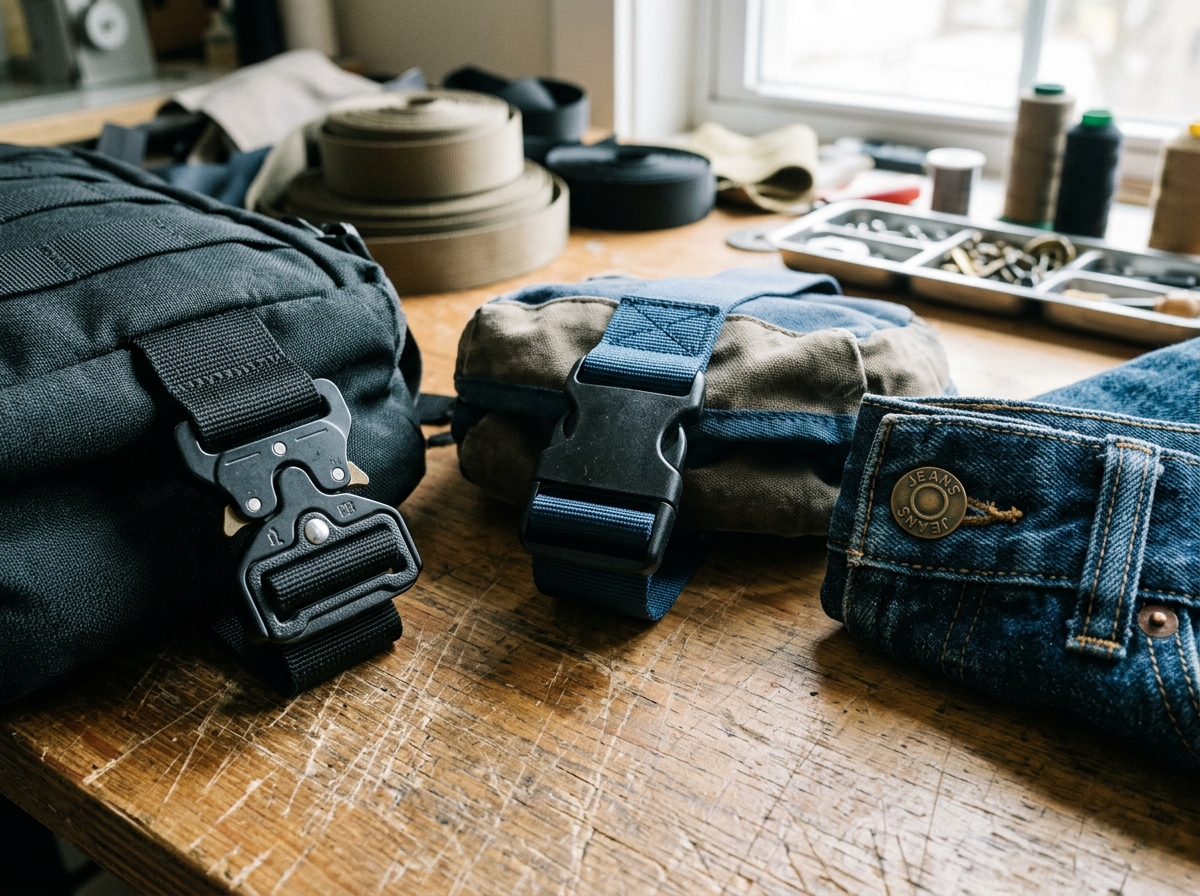
Material selection should follow the product’s load, environment, and user expectations. Metal hardware can provide a premium appearance, high stiffness, and a substantial tactile feel. It may also increase mass, create coating concerns, and require protection against corrosion or surface damage. Plastic hardware is often lighter and cost-efficient, but its performance depends on polymer type, geometry, molding quality, and exposure conditions.
For outdoor equipment, examine abrasion, ultraviolet exposure, moisture, temperature, and contamination. For luggage, examine repeated opening, impact during handling, and contact with conveyor or storage surfaces. For fashion bags, inspect plating uniformity, color matching, edge quality, and interaction with leather or coated fabric.
Compliance should be evaluated alongside mechanical design. If a product is intended for children, hardware size and detachment risk may be relevant to small-parts assessment. The U.S. Consumer Product Safety Commission small-parts guidance explains the testing concept and the approximate 31.7 mm test-cylinder diameter. Chemical restrictions may also apply depending on the market and material. The European Union REACH regulation is the official legal text for chemical registration, evaluation, authorization, and restriction requirements.
How to validate buckle dimensions before bulk production
A dimensional drawing should be approved together with a functional sample. A drawing defines the geometry, but only a complete sample shows whether the buckle works with the actual strap, seam, lining, and user interface.
- Define the use case. Record the bag type, expected load, adjustment method, operating frequency, environment, and target appearance.
- Measure the complete material stack. Include folded webbing, leather layers, binding, padding, coatings, and reinforcement patches.
- Request the supplier’s dimensional drawing. Confirm outside dimensions, inside opening, bar clearance, attachment width, material, finish, and allowable tolerance.
- Build a functional sample. Use production-intent materials and the intended sewing, riveting, or molding process.
- Inspect movement and comfort. Check feeding, adjustment, release force, sharp edges, noise, snagging, and contact with the user’s body.
- Approve a control sample. Keep the approved hardware and complete assembly sample as references for inspection and production communication.
Sampling should test variation, not just one successful unit. Compare hardware from different production batches when possible, because plating thickness, molding shrinkage, flash, surface finish, and dimensional variation can affect the fit. The procurement brief should identify critical dimensions and define which characteristics are cosmetic, functional, or safety-related.
Common mistakes when specifying buckle dimensions
Most buckle problems begin with incomplete specifications. Avoid describing hardware only as “small,” “heavy-duty,” or “standard size.” Those terms do not tell a supplier how the component will interact with the bag.
- Do not specify only the nominal strap width; include finished thickness and construction.
- Do not approve a loose buckle without testing the actual attachment method.
- Do not ignore the folded return path on adjustable straps.
- Do not compare metal and plastic hardware only by price or outside appearance.
- Do not treat a decorative buckle as nonfunctional if it carries load or controls movement.
- Do not change webbing construction after approval without repeating the fit check.
A complete sourcing specification reduces ambiguity between design, factory, and inspection teams. It should include a dimensioned drawing, material description, surface finish, color reference, tolerance notes, packaging requirements, test expectations, and approved application images. A cross-category sourcing partner can also coordinate matching webbing, hooks, rivets, snaps, zippers, and reflective components when the buckle is part of a larger hardware system. See the bag hardware and China sourcing service overview for the type of multi-supplier coordination such projects may require.
Designing for manufacturability and supply-chain control
The best buckle is the one that meets the design brief while remaining repeatable in production. Before approving a component, ask whether the selected size is available across the required order volume, whether the finish can be reproduced, and whether the supplier can maintain consistent dimensions across batches.
When a bag uses several related hardware pieces, standardizing compatible strap widths can simplify procurement and reduce the number of webbing constructions. However, standardization should not override functional needs. A buckle selected for a narrow fashion strap may not be suitable for a load-bearing backpack, even if both products use similar visual hardware.
For overseas purchasing, the project plan should connect product development with quotation, sampling, factory coordination, inspection, consolidation, and shipping. This is especially useful when one bag collection uses multiple categories such as webbing, fasteners, hook-and-loop tape, reflective materials, and zippers. The goal is not merely to find a low unit price; it is to control compatibility, quality, documentation, and delivery across the whole bill of materials.
FAQ
What does buckle size mean?
Buckle size usually refers to the strap width the component is designed to accept, but suppliers may use different reference points. Always confirm the inside opening, outside width, body thickness, bar clearance, and attachment geometry on a technical drawing.
Should the buckle opening exactly match the strap width?
Not necessarily. The opening needs enough controlled clearance for smooth feeding and adjustment, while avoiding excessive sideways movement. The correct relationship depends on the strap’s actual width, thickness, stiffness, coating, and folded construction.
Are metal buckles stronger than plastic buckles?
Not automatically. Strength depends on material, geometry, manufacturing quality, attachment design, and the direction of applied force. Compare complete assemblies rather than judging the buckle material alone.
How do I select buckle dimensions for a backpack?
Start with the load-bearing strap width and thickness, then review adjustment range, anchor reinforcement, user comfort, operating conditions, and repeated-use requirements. Test the buckle on a complete backpack section with production-intent materials.
Why can a buckle fit during sampling but fail in production?
Production may use different webbing thickness, coating, sewing tension, seam allowances, or hardware batches. Dimensional variation and assembly changes can alter the fit, so the approved sample must define both the component and the surrounding construction.
Do buckle dimensions affect children’s product compliance?
They can. Small detachable hardware may be relevant to product safety assessment, depending on the product and market. Review the applicable requirements and use official guidance, including the CPSC small-parts resource, before finalizing the design.
What information should I send when requesting a buckle quotation?
Provide the bag application, strap width and thickness, attachment method, material preference, finish, color, estimated order volume, target market, drawings or reference samples, packaging needs, and required inspection or compliance documents.
About the sourcing partner
TRAMIGO supports overseas buyers with coordinated sourcing across bag hardware, webbing, zippers, fasteners, hook-and-loop products, reflective materials, and related accessories. Its service model covers supplier matching, price comparison, sampling, factory coordination, quality inspection, consolidation, and logistics. For a new bag project, buyers can use the verified sourcing overview to discuss compatible buckle dimensions, complete samples, and multi-category purchasing requirements.

Post time: Oct-10-2026