

- Webbing width should be specified in millimeters, with a stated tolerance and finished-width measurement point.
- Webbing weight should identify the unit basis, such as grams per meter, so suppliers compare like with like.
- Webbing strength is incomplete without a test method, specimen condition, seam or hardware details, and a clear safety factor.
- Different applications require different priorities: lightweight luggage, load-bearing outdoor gear, and reflective safety products should not use the same selection logic.
- Samples, inspection records, and production testing are essential because identical width and fiber labels do not guarantee identical performance.
Webbing width, webbing weight, and webbing strength must be specified together because each describes a different purchasing risk. The National Institute of Standards and Technology identifies 25.4 millimeters as the exact equivalent of one inch, making a metric width specification easier to compare globally when buyers state the unit and tolerance clearly.
Why Webbing Width, Weight, and Strength Must Be Separated
Width, weight, and strength measure different characteristics, so one cannot safely substitute for another. A wider tape may distribute pressure more comfortably, but it is not automatically stronger. A heavier webbing may contain more material, but its construction, fiber type, and finishing process still determine the actual load result. A high breaking-strength value may also be unsuitable if the product is too stiff, bulky, or difficult to sew.
For example, a backpack shoulder strap may need a comfortable width, controlled flexibility, and abrasion resistance rather than the highest available tensile result. A cargo restraint or tactical attachment may prioritize load performance and resistance to repeated stress. A reflective safety garment may require visibility and sewability before maximum strength becomes the main selection criterion.
Buyers should therefore create a product specification that separates dimensional requirements, material requirements, mechanical requirements, and appearance requirements. This structure gives factories fewer opportunities to replace a critical requirement with a cheaper but unsuitable alternative.
How to Specify Webbing Width Correctly
Finished width is the first dimensional requirement because it affects hardware compatibility, sewing alignment, comfort, and the appearance of the final product. State the target width in millimeters, define the permitted tolerance, and clarify whether the measurement is taken before or after finishing.
Width should be checked at several points along the roll because weaving tension, coating, heat setting, and winding can create variation. A buyer should also confirm whether the width is measured across the flat tape, between selvedges, or across a coated surface. These details matter when the webbing must pass through a buckle, slide, hook, snap hook, or sewn channel.
The NIST conversion reference for inch-based specifications is useful when suppliers and buyers use different measurement systems: one inch equals 25.4 millimeters. However, conversion alone does not establish an acceptable tolerance. The tolerance must be agreed in the purchase specification and confirmed against a production sample.
| Illustrative width specification | Metric expression | Typical purchasing question |
|---|---|---|
| Half-inch reference | 12.7 mm | Will the tape pass through the selected small hardware? |
| One-inch reference | 25.4 mm | Does the finished width match the buckle or strap channel? |
| One-and-a-half-inch reference | 38.1 mm | Is the wider surface comfortable and stable in the intended use? |
| Two-inch reference | 50.8 mm | Can the product accommodate the additional bulk and bend radius? |
These are dimensional reference examples rather than universal product recommendations. The correct width depends on the hardware, user contact area, sewing method, and required load path.
How to Define Webbing Weight Without Confusion
Webbing weight is meaningful only when the unit basis and test condition are stated. Buyers commonly request grams per meter, but suppliers may quote weight per roll, per piece, or by a different length. Those figures cannot be compared directly without conversion.
Weight per meter is useful for estimating material consumption, freight planning, and product bulk. It is not a direct substitute for strength. Two polyester webbings with similar weight may differ in yarn count, weave density, coating, elongation, and finishing. One may feel soft and flexible, while the other may be stiff and abrasion resistant.
Ask the supplier to provide the basis of measurement, including whether the value includes coating, backing, adhesive, reflective film, or other treatment. For elastic woven tape, the buyer should also state whether weight is measured relaxed or under a defined extension. A relaxed sample and an extended sample can produce different practical results.
| Weight specification item | Why it matters | Buyer acceptance detail |
|---|---|---|
| Mass basis | Prevents comparison of grams per meter with total roll weight | State grams per meter or another agreed unit |
| Finished condition | Coatings and laminations can materially change mass | Include every permanent finish in the reported value |
| Moisture and conditioning | Textile materials may change behavior with environmental exposure | Use the agreed laboratory or factory conditioning method |
| Width relationship | A wider tape normally uses more material per meter | Compare weight only among products with equivalent width |
Weight should be treated as a logistics and handling indicator first, then as a supporting construction indicator. The final decision should remain tied to the application and verified mechanical performance.
 How to Specify Webbing Strength for Real Applications
Webbing strength must identify the test method because a breaking-strength value has no reliable meaning without a defined testing procedure. The ASTM D6775 standard page addresses breaking strength and elongation of textile webbing, strap, and narrow fabric, making it a relevant reference when buyers request comparable laboratory data.
Breaking strength is the force at which a test specimen fails under the stated test conditions. It is not automatically the same as the allowable working load in a finished product. Stitching, folds, knots, buckles, sharp edges, ultraviolet exposure, abrasion, moisture, and repeated loading can reduce system performance.
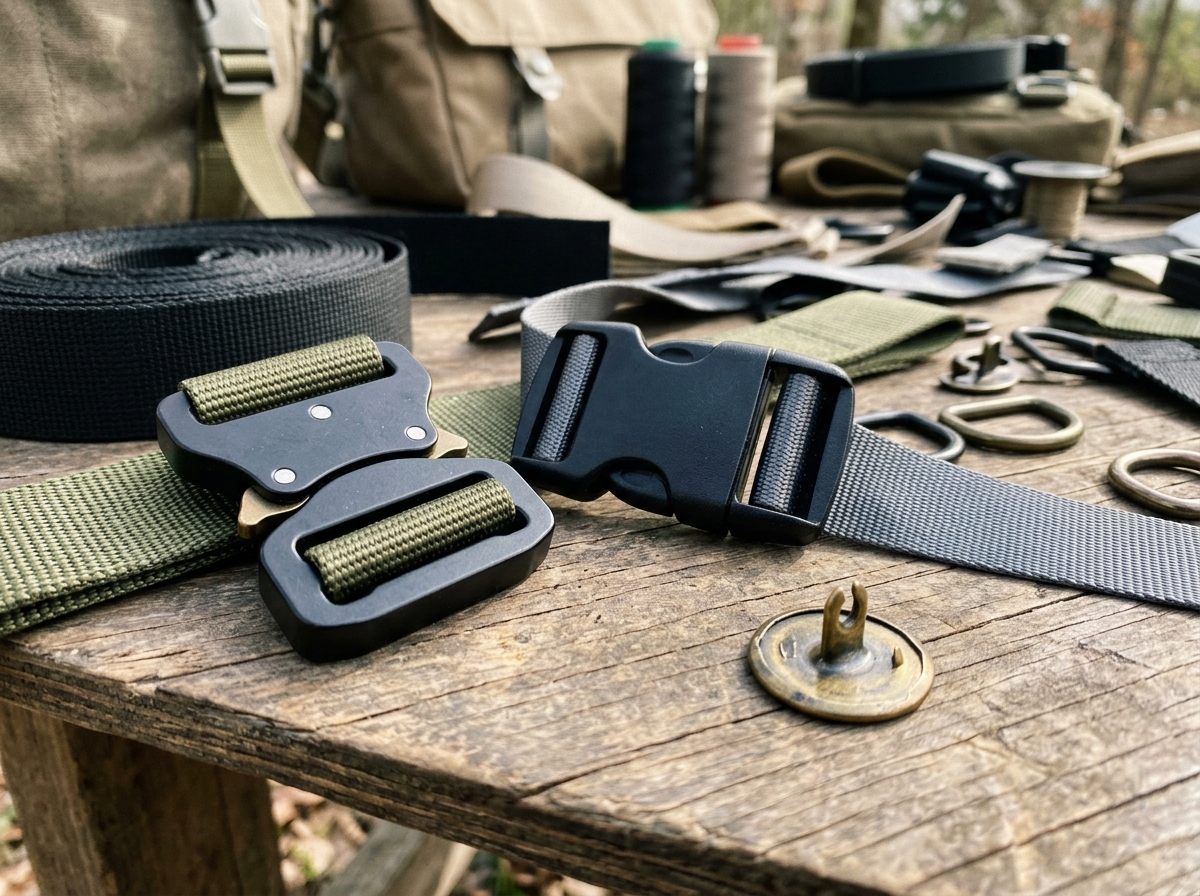
Buyers should specify whether the requirement applies to the webbing alone or to the complete assembly. For a backpack, the sewn joint may be the weak point. For a lashing system, the buckle or hook may fail before the tape. For a reflective webbing product, lamination or surface treatment may influence flexibility and long-term durability.
A useful strength specification includes the following elements:
- Fiber type and construction, such as polyester, nylon, polypropylene, woven, knitted, elastic, or non-elastic.
- Finished width, thickness, mass basis, and permitted dimensional tolerances.
- Required breaking strength and the test method used to measure it.
- Whether the value is a minimum requirement, an average result, or a typical supplier value.
- Conditioning, environmental exposure, and whether testing is performed on dry or treated specimens.
- Assembly details, including stitch pattern, thread, hardware, overlap, and seam direction.
For workplace visibility applications, strength is only one part of product suitability. The United States Occupational Safety and Health Administration regulation for signaling and safety devices illustrates why end-use conditions and protective performance requirements must be considered alongside material selection.
Webbing Selection by Application
The correct webbing specification changes with the load path, exposure, user contact, and assembly method. A sourcing team should begin with the finished product scenario rather than selecting a tape from a catalog name alone.
| Application | Primary requirement | Secondary checks | Common purchasing risk |
|---|---|---|---|
| Backpacks and bags | Comfortable width and reliable sewn strength | Abrasion, colorfastness, flexibility, hardware fit | Choosing a strong tape that is too stiff for repeated adjustment |
| Tactical and outdoor equipment | Load stability and abrasion resistance | Moisture behavior, edge durability, attachment compatibility | Using webbing strength data without testing the complete assembly |
| Safety garments | Visibility and secure attachment | Wash durability, flexibility, surface performance | Focusing on tensile results while ignoring reflective construction |
| Elastic garment components | Controlled stretch and recovery | Relaxed weight, extension condition, repeated-cycle behavior | Comparing elastic and non-elastic webbing with the same criteria |
| Industrial bundling | Stable tension and resistance to abrasion | Cut edges, temperature, chemical exposure, closure method | Confusing webbing breaking strength with permitted working load |
What Buyers Should Request Before Placing a Bulk Order
A pre-production sample is the fastest way to reveal whether the quoted specification works with the finished product. The sample should be made with the proposed yarn, construction, finish, color, and production process rather than a visually similar substitute.
Request a technical data sheet and a sample inspection record. The record should connect the tested sample to the production lot, identify the test method, and distinguish minimum guaranteed performance from typical results. If the product will be sewn, test the intended seam and hardware configuration as well as the tape itself.
- Confirm width and tolerance at multiple points along the roll.
- Confirm mass per agreed length and whether coatings are included.
- Confirm thickness, hand feel, elongation, and recovery where relevant.
- Confirm breaking-strength results and the exact test method.
- Check color, edge quality, fuzzing, contamination, winding, and roll length.
- Review performance after the relevant wash, abrasion, moisture, or exposure test.
Supplier comparison is more reliable when every quotation uses the same specification sheet. A sourcing partner can help compare factories, organize samples, coordinate inspection, consolidate multiple product categories, and manage export documentation, but the buyer should retain approval of the final technical requirement.
Common Specification Mistakes
The most costly mistake is requesting only a width and a strength number. Without fiber, construction, test method, tolerance, and application details, a supplier may meet the literal request while delivering a product that performs poorly in production.
Another mistake is treating catalog values as guaranteed production results. Catalog data may describe a typical construction, whereas a bulk order can involve a different yarn, dye lot, coating, or finishing process. Buyers should write minimum acceptable values into the purchase order and define the inspection process before production begins.
A final mistake is ignoring the connection between the webbing and the rest of the product. A strong tape can fail at a weak seam, and a suitable tape can become unsuitable when exposed to heat, chemicals, sunlight, repeated bending, or abrasive hardware.
FAQ
What is the most important webbing specification?
There is no single universal priority. For load-bearing products, verified assembly strength may lead. For apparel, comfort, flexibility, wash durability, and appearance may be more important. The specification should reflect the product risk.
Is wider webbing always stronger?
No. Width can support load distribution and hardware compatibility, but strength depends on fiber, yarn structure, weave, finishing, and testing. Require test evidence for the exact construction.
What unit should buyers use for webbing width?
Millimeters are practical for international purchasing because they reduce ambiguity. If an inch-based reference is used, state the converted metric value and the permitted tolerance.
How should webbing weight be quoted?
Request mass per agreed length, commonly grams per meter, and confirm whether coatings, laminations, adhesive, or other finishes are included.
What is the difference between breaking strength and working load?
Breaking strength describes failure under a defined test. Working load is a controlled application limit that must account for safety factors, hardware, seams, exposure, and repeated use. Do not use a breaking-strength value as an automatic working-load rating.
Should buyers test the webbing or the finished product?
Both may be necessary. Webbing-only testing helps compare material construction, while finished-product testing reveals the effect of seams, hardware, folds, and assembly details.
Can one webbing specification cover every product?
No. Backpack straps, tactical equipment, reflective safety garments, elastic apparel components, and industrial bundling have different performance priorities. Create application-specific specifications even when the products use similar tape.
About the Sourcing Partner
TRAMIGO supports overseas buyers with coordinated sourcing across webbing, hook and loop tape, reflective materials, zippers, buckles, snaps, cord systems, and other apparel and bag accessories. Its service model covers supplier matching, price comparison, sampling, factory coordination, quality inspection, consolidation, documentation, and logistics. This is useful for multi-category projects that require one purchasing workflow across multiple factories. Buyers can request product recommendations, samples, and a structured quotation based on width, weight, strength, application, and compliance needs.

Post time: Oct-14-2026