Why Material Choice Matters for Plain Webbing Tape in South
The South American manufacturing sector relies heavily on high-performance industrial textiles for logistics, outdoor equipment, and occupational safety gear. Whether producing cargo tie-downs for the Brazilian agricultural industry or climbing harnesses for Andean expeditions, the choice of raw material directly determines product lifespan and safety. Selecting the appropriate Plain Webbing Tape requires a thorough understanding of how different synthetic polymers react to the continent’s diverse environmental extremes, ranging from high-altitude ultraviolet (UV) radiation in the Andes to intense tropical humidity in the Amazon basin.
Key Differences Between Polyester and Nylon Webbing
Polyester (PET) and nylon (polyamide) represent the two dominant synthetic fibers used in commercial webbing production. The most critical operational difference lies in their interaction with moisture. Polyester is inherently hydrophobic, typically absorbing less than 0.4% of its own weight in water. This characteristic makes it highly resistant to rot, mildew, and dimensional changes in humid climates. In contrast, nylon is hydrophilic and can absorb up to 8.0% of its weight in moisture. When saturated, nylon can experience a 10% to 15% reduction in overall tensile strength.
Additionally, nylon offers higher elasticity, stretching up to 30% under heavy dynamic loads, whereas polyester remains dimensionally stable with a stretch factor limited to approximately 5% to 15%.
Common South American Applications and Performance Needs
Across South America, industrial applications demand specific performance metrics. In the logistics and agricultural sectors of Argentina and Colombia, flatbed trucks require heavy-duty cargo straps capable of securing loads over vast, rugged terrains. These applications generally mandate webbing with a minimum breaking strength (MBS) of 10,000 lbs (approximately 4,535 kg) and high resistance to environmental degradation.
Mining operations in Chile and Peru subject equipment to highly abrasive dust and extreme temperature fluctuations, often dropping below -10°C at night. In these harsh environments, material stability—sometimes enhanced by specialized UV or water-repellent coatings—is paramount to prevent sudden equipment failure and ensure worker safety during heavy lifting and material handling operations.
Polyester vs. Nylon Plain Webbing Tape: Performance Comparison
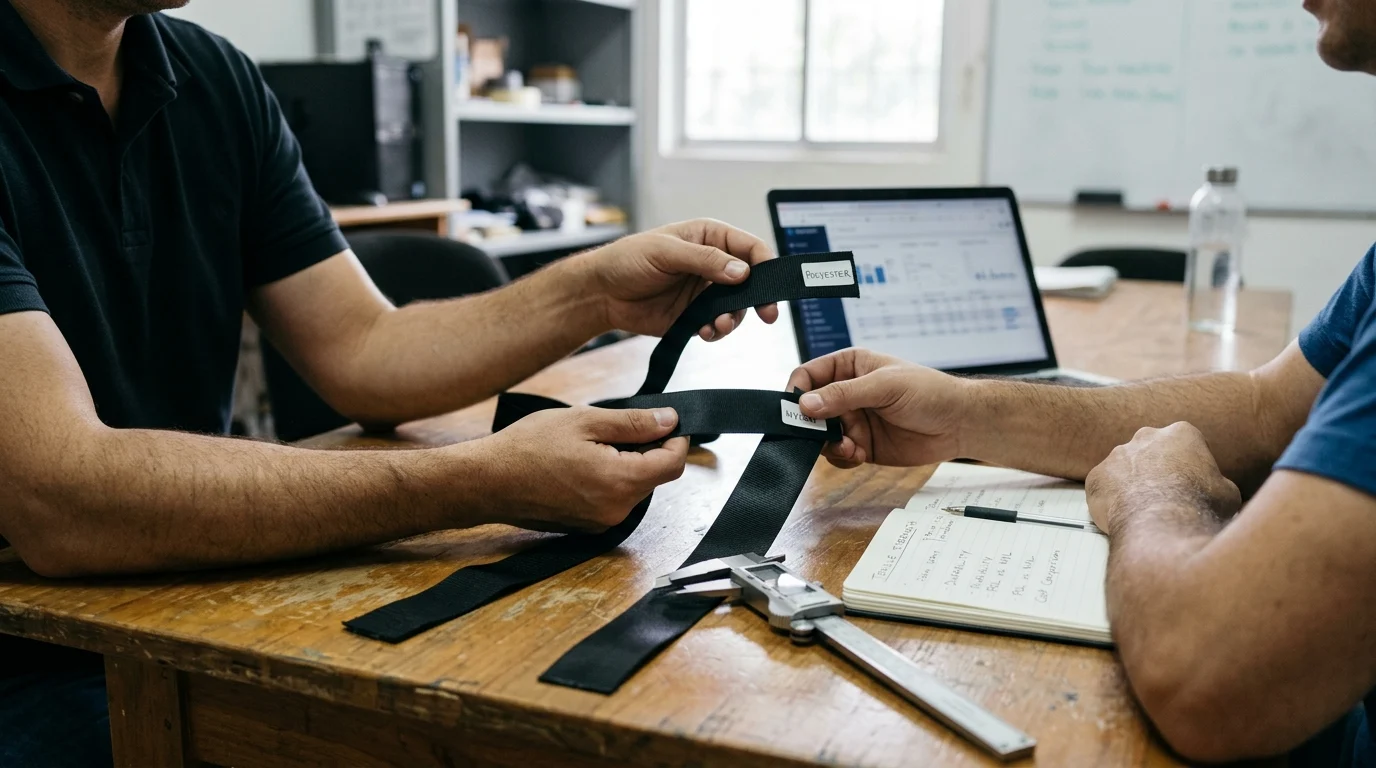
A direct technical comparison between polyester and nylon reveals distinct operational profiles. Manufacturers must evaluate these properties to align their product specifications with the rigorous demands of the South American industrial and consumer markets. In many cases, real-world procurement involves engineered solutions, such as applying UV stabilizers or water-repellent treatments, to mitigate a specific polymer’s natural vulnerabilities.
Tensile Strength, Stretch, Abrasion, and Weather Resistance
The physical mechanics of Plain Webbing Tape determine its suitability for specific tasks. Nylon excels in dynamic load applications due to its superior shock absorption capacity. However, polyester provides unparalleled advantages in static load scenarios. Under continuous UV exposure, polyester retains up to 90% of its baseline strength after extensive testing, whereas untreated nylon degrades significantly faster, becoming brittle and losing structural integrity over time.
| Performance Metric | Polyester Webbing | Nylon Webbing |
|---|---|---|
| Water Absorption | < 0.4% | Up to 8.0% |
| Stretch Under Load | 5% – 15% | 20% – 30% |
| UV Resistance | Excellent (Retains ~90% strength) | Moderate to Poor |
| Melting Point | ~260°C (500°F) | ~250°C (482°F) |
| Abrasion Resistance | High (Ideal for static friction) | Very High (Ideal for dynamic friction) |
Regional Standards, Safety Requirements, and Product Liability
Regulatory compliance is a critical factor for South American manufacturers. National regulatory frameworks, such as Brazil’s ABNT NBR 15637 standards for lifting slings and cargo securing devices, mandate strict adherence to safety factors. These regulations frequently require a 5:1 or 7:1 ratio of minimum breaking strength to the working load limit (WLL) to ensure operational safety. Furthermore, standardizing materials across MERCOSUR trade borders simplifies compliance and regional procurement.
Deploying non-compliant materials in safety-critical applications exposes manufacturers to severe product liability risks. Failure to meet regional safety thresholds can result in catastrophic accidents, leading to costly product recalls, legal liabilities, and regulatory fines that can easily reach tens of thousands of dollars, depending on the jurisdiction and the severity of the material failure.
How to Source, Test, and Specify Plain Webbing Tape
Establishing a reliable supply chain requires procurement teams to implement rigorous quality control protocols. Sourcing industrial textiles from international suppliers involves managing long lead times and stringent technical evaluations to ensure consistent manufacturing output.
Practical Sample Validation and Supplier Checks
When evaluating overseas suppliers for Plain Webbing Tape, manufacturers should request initial sample runs before committing to standard commercial minimum order quantities (MOQs), which typically range from 3,000 to 5,000 meters per color and width. In-house validation must include tensile testing, dye fastness evaluation (typically requiring a minimum grade 4 on the ISO grayscale), and abrasion testing (often targeting endurance benchmarks of 10,000 cycles on a standard abrader).
Procurement teams must also account for extended lead times and regional import tariffs; maritime shipping from major Asian textile hubs to South American ports like Santos (Brazil) or Callao (Peru) often requires 30 to 45 days. To maintain production integrity, a strict quality benchmark should enforce a defect rate of less than 1.0% per delivered production batch.
When to Choose Polyester Over Nylon
The decision to specify polyester over nylon should follow a clear environmental and operational framework rather than a simple binary choice:
- Choose Polyester when: The application involves static loads, continuous outdoor UV exposure, or high-moisture environments. Its low water retention and dimensional stability make it ideal for marine logistics, agricultural transport, and outdoor utility gear. It is also generally more cost-efficient for high-volume manufacturing, though bulk pricing fluctuates based on denier, width, and current trade tariffs.
- Choose Nylon when: High energy absorption and dynamic shock loading are the primary safety requirements. It should be reserved strictly for specialized applications such as fall-arrest lanyards, climbing harnesses, or heavy towing equipment.
- Consider Hybrids or Treatments when: Procurement demands the strengths of both materials.
Further reading:
Key Takeaways
- Choose polyester webbing for humid or outdoor South American applications because it absorbs less than 0.4% water and resists rot, mildew, and dimensional change.
- Use nylon webbing for dynamic load applications where elasticity and shock absorption are more important than low stretch or moisture resistance.
- Specify polyester for static cargo tie-downs because its typical 5% to 15% stretch range helps maintain stable tension over long transport routes.
- Avoid untreated nylon in prolonged UV exposure because polyester can retain up to 90% of baseline strength while nylon degrades faster and may become brittle.
- For heavy-duty agricultural and logistics straps, confirm a minimum breaking strength near 10,000 lbs, or 4,535 kg, before approving production.
- Consider UV stabilizers, water-repellent coatings, or abrasion-resistant finishes when supplying webbing for mining, tropical, or high-altitude environments.
Frequently Asked Questions
Which is better for humid South American climates, polyester or nylon webbing?
Polyester is usually better in humid regions because it absorbs less than 0.4% of its weight in water. Nylon can absorb up to 8.0%, which may reduce tensile strength by 10% to 15% when saturated.
When should manufacturers choose nylon Plain Webbing Tape?
Choose nylon when shock absorption and elasticity are critical, such as dynamic load applications. Nylon can stretch significantly under heavy loads, making it useful where controlled give is safer than rigid restraint.
Why is polyester often preferred for cargo straps and static loads?
Polyester offers lower stretch, better dimensional stability, and strong UV resistance. For static tie-downs, agricultural transport, and logistics straps, these properties help maintain tension and reduce load movement over long routes.
How does UV exposure affect polyester and nylon webbing?
Polyester generally performs better under prolonged UV exposure, retaining up to 90% of baseline strength in testing. Untreated nylon degrades faster, becoming brittle and losing structural reliability over time.
What breaking strength is commonly needed for heavy-duty cargo applications?
Heavy-duty cargo straps for logistics and agricultural use often require a minimum breaking strength of about 10,000 lbs, or approximately 4,535 kg, depending on the load, regulations, and safety factor.
Post time: Jun-26-2026