

- Match buckle geometry and nominal width to the actual webbing, not only the product name.
- Choose acetal or nylon according to impact, temperature, moisture, chemical, and appearance requirements.
- Specify closure force, adjustment behavior, pull testing, visual inspection, and sampling before production.
- Separate child-use compliance, outdoor performance, and general apparel requirements.
- Use a documented sourcing process when several buckle types or factories are required.
Plastic buckles are lightweight connection components, but their reliability depends on the complete system: buckle, webbing, stitching, adjustment path, and user load. The U.S. Consumer Product Safety Commission defines a small part using dimensions of less than 3.17 inches, or 80.5 mm, in length and less than 1.25 inches, or 31.8 mm, in diameter, or a similarly sized component under its small-parts rules. That makes age grading and intended use important considerations when buying outdoor gear buckles in bulk.
Why Plastic Buckles Need More Than a Price Comparison
The correct buying decision is based on system performance rather than the lowest quoted unit price.
A buckle may look acceptable during a showroom inspection yet fail after repeated adjustment, cold exposure, UV exposure, abrasion, or incorrect webbing installation. Outdoor products often experience combined stresses: a backpack buckle is pulled while the strap is angled, a compression strap is tightened against a hard load, and a protective cover may be opened and closed with one hand. The buckle should therefore be assessed in the same configuration in which it will be used.
Bulk buyers should also clarify whether the item is a standard catalog component or a custom-developed part. Standard parts usually reduce tooling and approval time. Custom parts can improve branding, ergonomics, or load distribution, but they require drawings, samples, mold review, color approval, and a stronger change-control process.
Material Selection for Outdoor Gear Buckles
Material selection should follow the exposure profile and failure risk of the finished product.
| Material family | Typical buying strength | Key questions | Numerical compliance reference |
|---|---|---|---|
| Acetal resin | Low moisture uptake and smooth movement are often valued for adjustable hardware | Will the part face impact, cold, abrasion, or repeated cycling? | 3.17 in and 1.25 in small-part dimensions may matter for child-use products |
| Nylon resin | Useful where toughness and impact resistance are priorities | How will moisture, heat, chemicals, and color variation be controlled? | 80.5 mm and 31.8 mm are converted dimensions from the CPSC reference |
| Recycled or filled resin | May support material goals or stiffness requirements | Is batch consistency proven through samples and records? | Use the same dimensional screen when the product is child-directed |
Acetal and nylon are not interchangeable simply because both are engineering plastics. Resin grade, additives, molding conditions, gate location, wall thickness, and post-mold deformation can change the finished behavior. Ask the supplier to identify the material family and to disclose whether the proposed color, recycled content, lubricant, or reinforcing additive changes performance.
Color is also a technical variable. Dark pigments, bright colors, translucent finishes, and fluorescent shades can require different process controls. Approve a physical color standard or master sample, and define acceptable variation before bulk production rather than relying on a digital image.
Dimensional Fit and Webbing Compatibility
The nominal buckle width must match the webbing width and the actual slot geometry.
A strap can be too thick for a slot, too narrow for stable adjustment, or too stiff to pass through the intended path. Measure the webbing under realistic tension and check the assembled product, because textile thickness can change with coating, folding, stitching, and compression. The supplier should provide a dimensioned drawing showing slot width, external width, wall thickness, pin or bar diameter, and the direction of load.
| Inspection item | What to verify before approval | Recorded value | Why it matters |
|---|---|---|---|
| Slot width | Actual opening compared with the approved webbing | Use the approved drawing value | Controls insertion, adjustment, and strap retention |
| Overall length | Fit inside the product pattern or molded housing | Use the approved drawing value | Prevents interference with seams and panels |
| Small-part screen | Apply the intended-use review where children may access the component | 3.17 in length; 1.25 in diameter reference | Supports product safety review under CPSC guidance |
| Webbing width | Measure the actual strap rather than using a nominal label only | Record in millimeters or inches | Reduces slippage and assembly variation |
Do not approve a buckle from a photograph. A functional sample should be threaded with production-equivalent webbing, stitched or assembled using the intended construction, and operated by the people who will use or pack the finished item.
Closure Design, Load Direction, and User Experience
A buckle should be tested in the direction and handling pattern expected in the field.
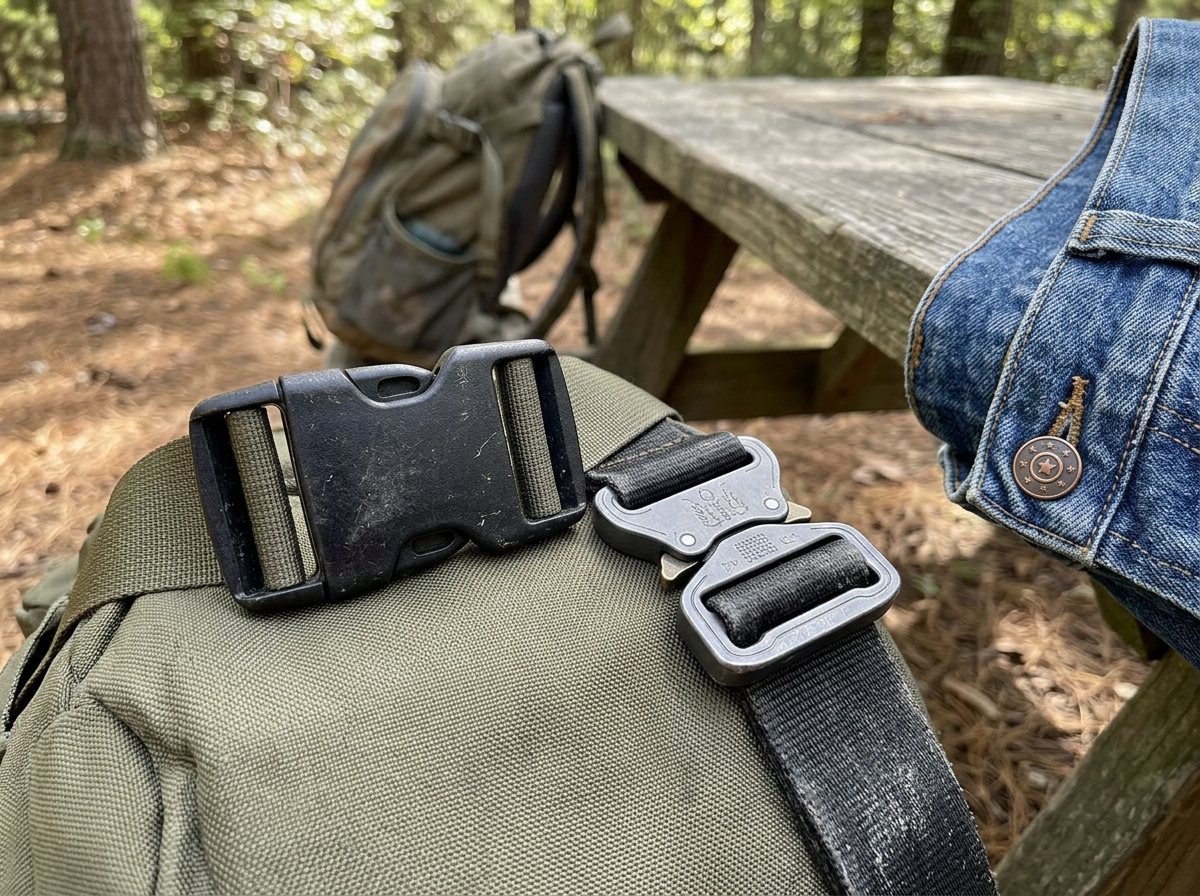
Side-release buckles, ladder locks, tri-glide adjusters, sternum buckles, and cam-style components solve different problems. A side-release closure is convenient for frequent opening, while a ladder lock is primarily used for adjustment. A component that holds well in a straight pull may behave differently under diagonal loading or when the strap is twisted.
Evaluate these questions during sampling:
- Can the user open the closure while wearing gloves?
- Does the buckle close with a clear tactile or audible engagement?
- Can the strap be adjusted without excessive force?
- Does the webbing creep when the product is loaded?
- Are edges smooth enough to avoid cutting the strap or irritating the user?
- Can the component be assembled efficiently without damaging the molded part?
For safety-related or load-bearing products, define the test method before comparing factories. Specify the assembled strap configuration, loading direction, conditioning, acceptance criteria, and failure definition. A buckle pull test alone cannot validate the complete product if the stitching, webbing, or attachment loop is weaker than the hardware.
Quality Control Before a Bulk Buckles Order
Pre-production approval is the most efficient point to prevent a repeated defect across a large shipment.
A practical inspection plan should cover appearance, dimensions, function, material identity, color, packaging, and traceability. Visual checks can identify flash, short shots, sink marks, warpage, sharp edges, contamination, color mismatch, and incomplete release. Functional checks should include threading, closure, release, adjustment, and interaction with the actual strap.
For products used by children, review the CPSC small parts regulation guidance before finalizing the design. The CPSC reference states that small parts are assessed using dimensional criteria including less than 3.17 inches in length and less than 1.25 inches in diameter. This is not a substitute for a product-specific compliance assessment, but it is a useful early design screen.
For workplace or protective equipment, the buyer should also review the relevant hazard assessment and PPE obligations. The U.S. Occupational Safety and Health Administration PPE standard explains that protective equipment selection should address workplace hazards and proper fit. That principle applies to buckle selection when hardware is part of a vest, harness, protective garment, or load-supporting system.
 Bulk Buckles Ordering Checklist
A clear purchase specification reduces ambiguity between the buyer, mold supplier, and assembly factory.
- Define the finished-product application, user group, load direction, and exposure conditions.
- Send the exact webbing sample, width, thickness, weave, coating, and construction method.
- Request a dimensioned drawing, material declaration, color sample, and available test information.
- Approve a production-equivalent sample before discussing mass-production acceptance.
- Confirm mold ownership, cavity identification, revision control, and procedures for design changes.
- Agree on inspection points for appearance, dimensions, function, packaging, and labeling.
- Specify carton protection, inner-bag quantities, lot identification, and shipping documentation.
When several components are purchased together, consolidate the specification into one bill of materials. This is especially valuable for backpacks, outdoor apparel, luggage, safety vests, and tactical accessories that combine buckles, webbing, cord, stoppers, hook and loop tape, reflective materials, and zippers.
Common Sourcing Mistakes
The most expensive mistakes usually come from incomplete specifications rather than from the molding process itself.
| Mistake | Immediate symptom | Procurement correction | Priority level |
|---|---|---|---|
| Choosing by photograph | Unexpected slot size or closure feel | Approve a dimensioned sample with production webbing | High |
| Changing resin without review | Different stiffness, color, or impact behavior | Require written material approval before substitution | High |
| Testing the buckle alone | Strap or stitching fails first | Test the complete assembled system | High |
| Ignoring packaging | Scratches, deformation, or mixed lots | Define packing and lot identification in the purchase order | Medium |
Another common error is treating a sample approval as a permanent waiver for future changes. Tool maintenance, resin availability, pigment changes, and factory transfers can alter a component. Require notification and reapproval when the material, mold, production site, dimensions, or surface finish changes.
How a China Sourcing Partner Can Reduce Coordination Risk
A multi-category sourcing partner is most useful when the project involves several factories, specifications, and shipment milestones.
The buyer may need plastic buckles together with webbing, reflective tape, zippers, cord, stoppers, metal hooks, or other apparel and bag accessories. Managing each supplier separately increases the chance of mismatched colors, incomplete documentation, inconsistent packaging, and split delivery dates. A coordinated process can combine supplier search, quotation comparison, sampling, factory communication, inspection, consolidation, and logistics planning.
The right partner should still work from objective requirements. Ask for comparable quotations, clear sample records, transparent revision history, inspection photographs, and a defined escalation process for nonconforming goods. Supplier breadth is valuable only when it is combined with disciplined technical communication and quality control.
FAQ
What are the best plastic buckles for outdoor gear?
The best buckle is the one whose material, geometry, closure behavior, and attachment method match the product load and environment. There is no universal best type for every backpack, cover, vest, or tactical accessory.
Should I choose nylon or acetal buckles?
Compare the resin grade and the expected exposure rather than choosing by material name alone. Review impact, moisture, temperature, chemical contact, UV exposure, stiffness, color, and repeated-use requirements with the supplier.
What should I send a supplier before requesting a quotation?
Send the application, webbing sample, target dimensions, color reference, estimated order quantity, packaging needs, delivery destination, and any required testing or compliance documentation.
How do I test outdoor gear buckles before bulk ordering?
Test production-equivalent samples in the complete assembly. Include threading, adjustment, closure, release, diagonal loading, repeated operation, environmental conditioning where relevant, and inspection of the webbing and stitching.
Are plastic buckles suitable for safety equipment?
They may be suitable for some applications, but suitability depends on the product design, applicable regulations, load path, material, and test evidence. A decorative or adjustment buckle should not automatically be treated as a load-bearing safety component.
What is the difference between standard and custom buckles?
Standard buckles usually offer faster sampling and lower development complexity. Custom buckles can provide a unique shape, logo, release action, or fit, but they require tooling decisions, drawings, approval samples, and change control.
Can one supplier coordinate buckles and other accessories?
Yes, a sourcing partner can coordinate multiple accessory categories, but the buyer should maintain one approved bill of materials, separate specifications for each component, and clear inspection criteria for every shipment lot.
About TRAMIGO
TRAMIGO supports overseas buyers with China sourcing and export procurement across apparel trims, bag hardware, webbing, zippers, reflective materials, hook and loop tape, buckles, and functional accessories. Its service model covers supplier matching, quotation comparison, sampling, factory coordination, quality inspection, consolidation, and logistics. For a multi-category outdoor project, review the sourcing service and contact the team to discuss samples, specifications, and bulk ordering requirements.

Post time: Oct-05-2026