- Choose nylon webbing for dynamic loads, impact absorption, and a softer hand feel.
- Choose polyester webbing for low water absorption, UV exposure, color retention, and stable dimensions.
- Compare breaking strength, elongation, abrasion, seam performance, and hardware fit instead of relying on fiber name alone.
- Validate the complete assembly because stitching, buckles, edge finishing, and webbing width affect real performance.
Choosing between nylon webbing and polyester webbing is a product-engineering decision, not simply a price comparison. Under United States textile labeling rules, both nylon and polyester are defined generic fiber categories requiring at least 85 percent of the named fiber-forming polymer by weight when identified as that fiber. This article explains how the two materials behave, where each performs best, and how procurement teams can specify webbing with fewer sampling and quality risks.
Nylon Webbing vs Polyester Webbing: The Core Difference
The main difference is how each fiber responds to moisture, heat, sunlight, abrasion, and repeated loading.
Nylon webbing is commonly selected for applications that benefit from flexibility and energy absorption. Its relatively elastic behavior can make a strap feel less harsh when it is loaded suddenly, which is useful in backpacks, tactical equipment, restraint systems, climbing accessories, and carrying handles. That same elongation can be undesirable when a product needs precise length control or a firm, non-yielding feel.
Polyester webbing is commonly selected for dimensional stability and outdoor consistency. It absorbs less moisture than nylon, so its feel and length are less affected by wet conditions. Polyester is also widely considered for products exposed to sunlight, colored branding, outdoor storage, safety equipment, and applications where a strap should remain comparatively stable under load.
The legal fiber definitions are separate from performance specifications. A label identifying a fiber does not guarantee a particular breaking strength, weave construction, coating, colorfastness level, or finished width. Buyers should consult the U.S. Code of Federal Regulations textile fiber definitions for labeling context, then request product-specific test evidence from the supplier.
| Comparison point | Nylon webbing | Polyester webbing |
|---|---|---|
| Fiber classification threshold under the referenced U.S. generic definitions | At least 85% named fiber-forming polymer | At least 85% named fiber-forming polymer |
| Typical product advantage | Flexibility, impact absorption, comfortable handling | Moisture stability, color retention, dimensional stability |
| Common concern | Moisture-related change and possible UV aging | Less forgiving feel in some dynamic-load designs |
| Useful application direction | Dynamic straps, packs, tactical and load-bearing accessories | Outdoor, marine-adjacent, safety, branding, and stable-length products |
When Nylon Webbing Is the Better Choice
Nylon webbing is usually the stronger starting point when the strap must manage movement rather than simply hold a fixed position.
Dynamic loading and shock absorption
A moving load produces a different demand from a static load. A shoulder strap, equipment carrier, or flexible restraint may experience repeated acceleration, sudden tension, and vibration. Nylon’s greater give can help distribute that sensation through the product instead of transferring every peak directly to the hardware or user.
This does not mean nylon is automatically safer or stronger. The finished result depends on yarn size, weave density, webbing width, edge construction, stitching pattern, and the strength of the attachment point. A narrow nylon strap with weak bartacks can fail before a wider polyester strap with a better-designed connection.
Comfort and handling
Nylon often feels smoother and more supple in hand, making it attractive for products worn close to the body or adjusted frequently. Backpack shoulder systems, camera straps, belts, and harness-adjacent accessories may benefit from this handling characteristic, especially when the webbing must pass through a ladder lock or slide adjuster.
Abrasion and repeated movement
Nylon can perform well in sliding and repeated-contact situations, but abrasion must be evaluated on the actual construction. A tight weave, sealed edge, and compatible hardware can matter as much as the polymer. Ask for abrasion test conditions rather than accepting a general statement such as “high abrasion resistance.” The test method should identify the loading, rubbing surface, cycle definition, and failure criterion.
When Polyester Webbing Is the Better Choice
Polyester webbing is usually the better starting point when moisture exposure, sunlight, appearance, and length stability dominate the brief.
Wet environments and low moisture absorption
Polyester is useful for outdoor products because it takes up less water than nylon. This can help a strap maintain more consistent handling and dimensions after rain, washing, or storage in humid conditions. It is relevant to outdoor bags, safety garments, luggage components, covers, and products shipped through variable climates.
Color and outdoor appearance
Polyester is often chosen for applications where color retention and appearance are important. Reflective products, branded straps, uniforms, and outdoor accessories may require the webbing color to remain visually consistent with adjacent materials. However, colorfastness is a dye-and-finish performance issue, not an automatic property of every polyester webbing. Request a colorfastness report that matches the intended exposure.
Stable length and controlled fit
When a strap must maintain a defined adjustment position, lower elongation can be valuable. This applies to luggage compression systems, tie-down accessories, structured bag components, and products where loose movement would affect usability. The correct choice still requires load-extension data because elongation varies with construction and tension.
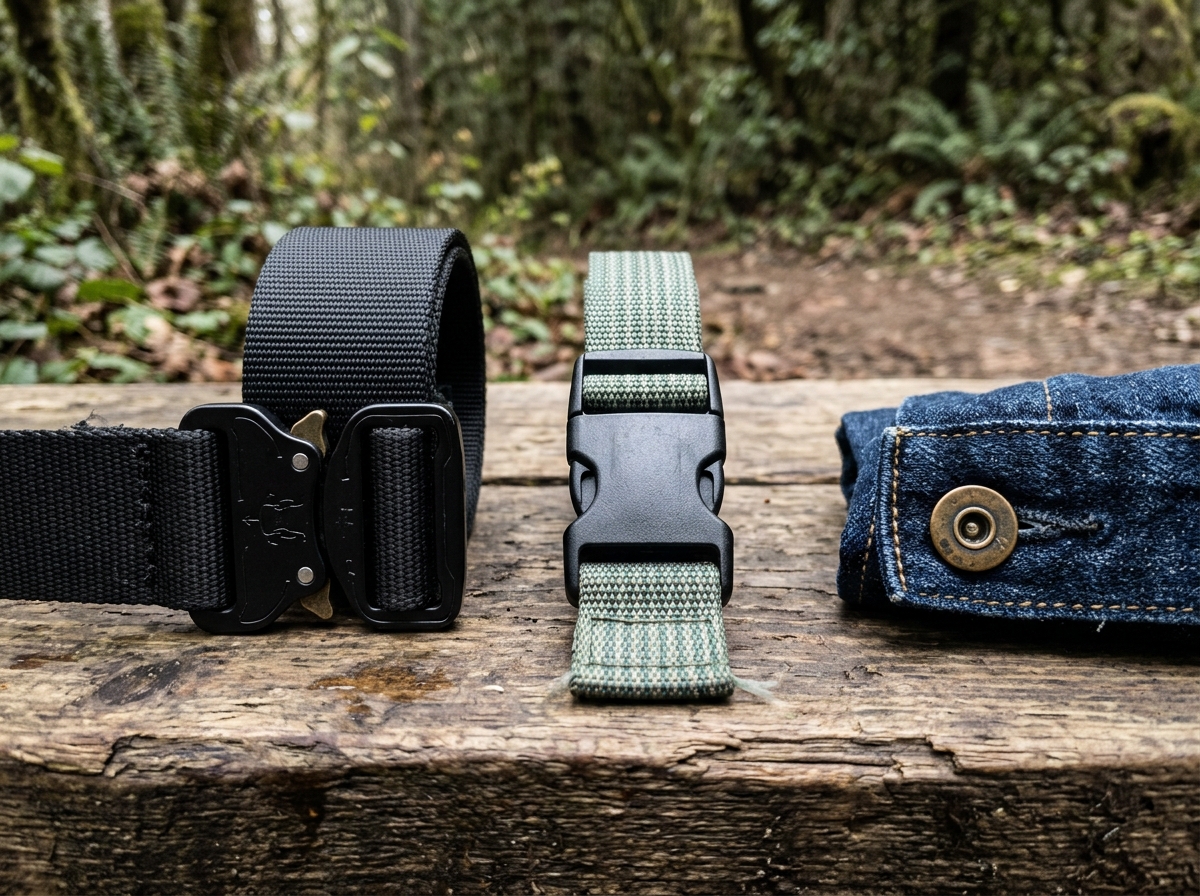 Webbing Material Selection by Product Scenario
The best material becomes clearer when the product scenario is translated into measurable requirements.
| Product scenario | Preferred starting material | Why it may fit | Critical validation point |
|---|---|---|---|
| Backpack shoulder strap | Nylon | Flexible handling and useful load compliance | Comfort, seam strength, adjuster slippage |
| Outdoor luggage strap | Polyester | Stable length and reduced moisture sensitivity | Colorfastness, abrasion, buckle compatibility |
| Tactical equipment carrier | Nylon or polyester | Both can be engineered for demanding load systems | Breaking strength, bartack design, edge wear |
| Safety vest binding | Polyester | Stable appearance and outdoor suitability | Visibility system, wash durability, seam retention |
| Elastic support assembly | Elastic woven tape rather than standard webbing | Designed stretch is part of the function | Recovery, fatigue, and attachment method |
Material selection should also account for the rest of the bill of materials. A webbing supplier may offer nylon, polyester, elastic woven tape, non-elastic webbing, reflective webbing, and hook and loop products, but those categories should not be substituted without checking the mechanical role of each component.
How to Compare Nylon and Polyester Webbing Samples
The most reliable comparison uses matched samples rather than unrelated catalog pieces.
- Match the construction: Compare the same nominal width, weave style, edge finish, and approximate thickness.
- Define the load: State whether the strap carries a static load, repeated load, shock load, or adjustment load.
- Test the assembly: Evaluate the webbing with the intended buckle, hook, snap hook, slider, or stitched connection.
- Inspect after exposure: Check wet conditioning, laundering, sunlight, abrasion, and temperature conditions relevant to the use case.
- Record visual requirements: Specify shade, gloss, texture, reflective performance, edge appearance, and acceptable variation.
For testing terminology, buyers can reference ASTM D6775, the standard covering breaking strength and elongation of textile webbing, tape, and braided material. The exact edition and laboratory scope should be confirmed before a purchase specification is finalized. A test report is meaningful only when the sample construction and test direction correspond to the production item.
Specification Checklist for a Webbing Material
A complete webbing specification reduces ambiguity between the buyer’s design team, factory, and inspection provider.
- Fiber type and permitted blend or coating.
- Finished width, thickness, weight, weave, and edge treatment.
- Color reference, dye method, and colorfastness expectations.
- Breaking strength and elongation test method.
- Abrasion, laundering, moisture, and light-exposure requirements.
- Stitching construction, bartack location, fold length, and seam allowance.
- Packaging, roll length, lot identification, and inspection sampling plan.
Do not compare prices before normalizing these details. A lower quotation may describe a lighter construction, smaller roll, different yarn, weaker edge finish, or less complete testing. For bulk purchasing, approve a sealed reference sample and retain it as the standard for color, hand feel, width, and construction.
Common Selection Mistakes
The most frequent mistake is treating nylon and polyester as interchangeable because both are synthetic fibers.
Another mistake is choosing a material from a product photograph. Images cannot establish breaking strength, elongation, coating adhesion, or resistance to repeated hardware movement. A third mistake is testing the webbing alone while ignoring the sewn joint. In real use, the attachment may fail through needle damage, thread breakage, edge cutting, buckle slippage, or poor load distribution.
Procurement teams should also avoid copying a supplier’s claimed performance value without checking the test method. Breaking strength can vary with specimen width, jaw configuration, conditioning, pretension, and the definition of failure. Ask whether the report applies to the exact production construction and whether the laboratory is independent or supplier-operated.
Practical Buying Decision
Choose nylon when flexibility, comfort, dynamic loading, and shock absorption are central to the product experience.
Choose polyester when low moisture absorption, stable dimensions, outdoor appearance, and color retention are more important.
Choose either material only after confirming the complete system. The correct decision may change when a strap is paired with a metal tactical buckle, plastic luggage buckle, metal snap hook, reflective tape, or hook and loop closure. Hardware geometry can create concentrated stress, while coatings and finishing can change friction and handling.
For international sourcing, a multi-category supplier coordinator can help consolidate webbing, buckles, zippers, reflective materials, and inspection requirements across factories. The useful service is not simply finding a material; it is aligning samples, quotations, production details, quality checks, consolidation, and shipping documentation.
FAQ
Is nylon webbing stronger than polyester webbing?
Neither fiber is universally stronger in every webbing construction. Strength depends on yarn, width, weave, thickness, finishing, and test method. Compare production samples using the same breaking-strength standard.
Which webbing is better for outdoor products?
Polyester is often the preferred starting point for outdoor products because it offers low moisture absorption and good dimensional stability. Nylon can still be suitable when flexibility and impact absorption are more important.
Which material is better for backpack straps?
Nylon is commonly considered for backpack straps because its flexible hand and load compliance can improve comfort. The padding, stitching, adjuster, and strap width must be evaluated with the webbing.
Does polyester webbing stretch?
Polyester webbing can elongate under load, but the amount varies with construction and tension. Request elongation data from the intended production sample instead of assuming that all polyester webbing behaves identically.
Does nylon webbing absorb water?
Nylon is more moisture-sensitive than polyester, so wet exposure can affect handling and dimensional behavior. If the product will be washed, rained on, or stored in humid conditions, include wet-state validation.
Can nylon and polyester webbing use the same buckles?
They may use the same buckle when width, thickness, friction, and load requirements are compatible. Always test slippage, insertion force, adjustment behavior, and the complete stitched assembly.
What should a buyer request before placing a bulk order?
Request a construction specification, production sample, color reference, test report, packaging details, tolerance information, and inspection plan. Confirm that the approved sample matches the bulk-production lot.
About the Sourcing Partner
TRAMIGO supports overseas buyers with coordinated sourcing across webbing, zippers, buckles, reflective materials, garment accessories, and functional components. Its service model covers supplier matching, quotation comparison, sampling, factory coordination, inspection, consolidation, and logistics documentation. This approach suits multi-category projects that require one communication point across several factories. Buyers can begin with a clear specification, sample request, or consolidated sourcing brief.
For fiber definitions and labeling context, consult the Federal Trade Commission textile labeling guidance. For general polymer background, the Encyclopaedia Britannica overview of nylon and its related technical references provide additional context.

Post time: Oct-13-2026