


Introduction
Outdoor gear often fails to stand out when visibility matters most: at dusk, in rain, or under a headlamp beam. Reflective webbing tape addresses that problem by combining load-bearing webbing with retroreflective performance, so straps, belts, and attachment points become easier to spot without adding separate trim or unnecessary bulk. This article explains how the material works, where it delivers the biggest safety and design advantages, and why it has become a practical upgrade for packs, harnesses, and other equipment used in low-light conditions. From recognition distance to manufacturing efficiency, the sections ahead show how a small material change can improve both function and user confidence.
Why Reflective Webbing Tape Is a Strategic Visibility Upgrade
Reflective webbing tape represents a critical convergence of structural integrity and user safety in outdoor gear manufacturing. Traditionally, visibility elements were treated as secondary appliqués, sewn or ironed onto finished fabrics. By integrating retroreflective properties directly into the load-bearing webbing—such as backpack straps, harness points, and compression belts—designers can achieve high-visibility performance without adding redundant material weight (typically saving 15 to 30 grams per linear meter compared to sewn-on tapes) or compromising the structural footprint of the gear.
For manufacturers, transitioning to reflective webbing tape is not merely an aesthetic choice but a strategic upgrade. It consolidates the supply chain by merging two components (webbing and reflective tape) into one, while simultaneously meeting stringent safety demands for low-light outdoor environments.
How it improves low-light recognition
The primary mechanism behind reflective webbing tape is retroreflection, typically achieved through either exposed high-index glass beads (refractive index $N_d \ge 1.9$ and typical diameters of 40–60 microns) or microprismatic arrays embedded into or bonded onto the webbing substrate. Unlike standard luminescent or fluorescent materials that rely on ambient UV light, retroreflective elements return directional light directly to its source, such as a vehicle’s headlights or a search-and-rescue flashlight.
In low-light scenarios, human visual perception relies heavily on biomotion—the ability to recognize human movement patterns. By placing reflective webbing on articulating points like shoulder straps or waist belts, gear manufacturers maximize biomotion cues. High-quality reflective yarns or thermal-transfer films applied to webbing routinely achieve a coefficient of retroreflection ($R_A$) exceeding 330 cd/lux/m². At this threshold, the wearer becomes highly recognizable to motorists or search teams at distances surpassing 200 meters, a critical safety margin for nighttime alpine ascents or pre-dawn cycling commutes.
What market pressures are driving adoption
The adoption of reflective webbing tape is accelerating due to intersecting market pressures from both regulatory bodies and consumer expectations. The outdoor equipment sector has seen a 15% to 20% year-over-year increase in demand for dual-purpose gear—equipment that performs equally well in rugged wilderness environments and urban commuting scenarios. This “commuter-to-crag” consumer segment requires unobtrusive safety features that do not scream “construction worker” during daylight but offer uncompromising visibility at night.
Furthermore, the rise of ultra-endurance sports, which inherently involve nighttime navigation, has forced gear brands to elevate their visibility specifications. Liability considerations and the push for EN 1150 (visibility clothing for non-professional use, requiring a minimum of 0.015 m² of reflective material) compliance in the European market have effectively mandated the inclusion of highly durable, integrated reflective materials in premium outdoor packs, pet harnesses, and technical apparel.
How to Evaluate Reflective Webbing Tape Performance

Evaluating the performance of reflective webbing tape requires a dual-pronged approach: assessing the mechanical properties of the base webbing and the photometric longevity of the reflective element. A failure in either dimension renders the component unsuitable for extreme outdoor applications.
Material, construction, and retroreflective design
The foundation of reflective webbing tape is typically nylon, polyester, or, for ultra-lightweight applications, UHMWPE (Ultra-High-Molecular-Weight Polyethylene). Polyester is frequently preferred for outdoor gear due to its inherent UV resistance and low moisture absorption (<0.4%), which prevents the webbing from warping and subsequently cracking the reflective surface. Nylon offers superior tensile strength (often exceeding 1,800 kg / 4,000 lbs break strength for a standard 25mm width) and elasticity but requires specific hydrophobic treatments to maintain dimensional stability in wet conditions.
The retroreflective design usually takes one of two forms: woven-in reflective yarn or laminated heat-transfer film. Woven designs interlace metallized glass bead yarns directly into the warp or weft of the webbing. This method provides excellent flexibility and longevity. Conversely, heat-transferred continuous stripes offer higher initial reflectivity ($R_A$ values often peaking around 400 to 500 cd/lux/m²) but can increase the stiffness of the webbing and alter its hand-feel.
Abrasion, durability, and visibility comparisons
Durability in outdoor gear is heavily dependent on abrasion resistance and washability. Under the ISO 6330 standard for domestic washing, a premium reflective webbing tape must maintain a minimum $R_A$ of 100 cd/lux/m² after 50 wash cycles. Heat-transferred films are particularly susceptible to delamination if the adhesive bond is compromised by repeated flexing or exposure to DEET-based insect repellents.
When subjected to the Martindale abrasion test (ISO 12947-2), woven reflective yarns generally outperform continuous films. Films may begin to show micro-cracking after 10,000 to 15,000 rubs, leading to a rapid degradation of continuous visibility. Woven yarns, protected slightly by the surrounding non-reflective polyester or nylon threads, often retain up to 80% of their baseline reflectivity even after 25,000 abrasion cycles, making them superior for high-friction zones like backpack shoulder straps.
A practical comparison framework for buyers
To navigate these variables, procurement and engineering teams should utilize a standardized comparison framework when evaluating vendor samples. The following table illustrates a typical comparative baseline between the two dominant construction methods.
| Construction Method | Initial Reflectivity ($R_A$) | Retention after 50 Washes | Tensile Strength Impact | Typical Cost Premium |
|---|---|---|---|---|
| Woven-in Reflective Yarn | 250 – 350 cd/lux/m² | High (>80% retention) | Negligible | 25% – 35% |
| Heat-Transfer Lamination | 400 – 500+ cd/lux/m² | Moderate (60-70% retention) | Adds stiffness/rigidity | 15% – 20% |
| Segmented Heat-Transfer | 350 – 450 cd/lux/m² | Moderate-High (75% retention) | Low (maintains flex) | 30% – 40% |
By mapping specific gear requirements against this framework, brands can specify the exact material profile needed. For instance, a heavy-duty climbing harness requires maximum tensile integrity and abrasion resistance, favoring woven-in yarns, whereas a lightweight running vest might prioritize the sheer photometric output of a continuous heat-transfer film.
Compliance, Quality Control, and Sourcing
Transitioning from material evaluation to mass production introduces complex sourcing dynamics. Procurement teams must navigate a labyrinth of international safety standards, strict chemical compliance regulations, and regional manufacturing nuances to ensure the reflective webbing tape performs reliably at scale.
Relevant safety, chemical, and performance standards
Reflective webbing tape intended for high-visibility applications must often align with stringent international standards. While EN ISO 20471 and ANSI/ISEA 107-2020 are primarily designed for occupational high-visibility safety apparel, premium outdoor gear brands frequently benchmark their webbing against these standards, specifically targeting the minimum retroreflective performance requirement of 330 cd/lux/m² for Level 2 materials.
Chemical compliance is equally critical. The glass beads used in retroreflective arrays can inadvertently introduce heavy metals into the supply chain if not strictly controlled. Suppliers must comply with Oeko-Tex Standard 100 (Class II for skin contact) and the EU’s REACH regulation, ensuring that restricted substances, such as lead and cadmium, remain strictly below the 0.1% threshold by weight. Failure to verify chemical compliance can result in costly border rejections and severe brand damage.
Supplier qualification and testing steps
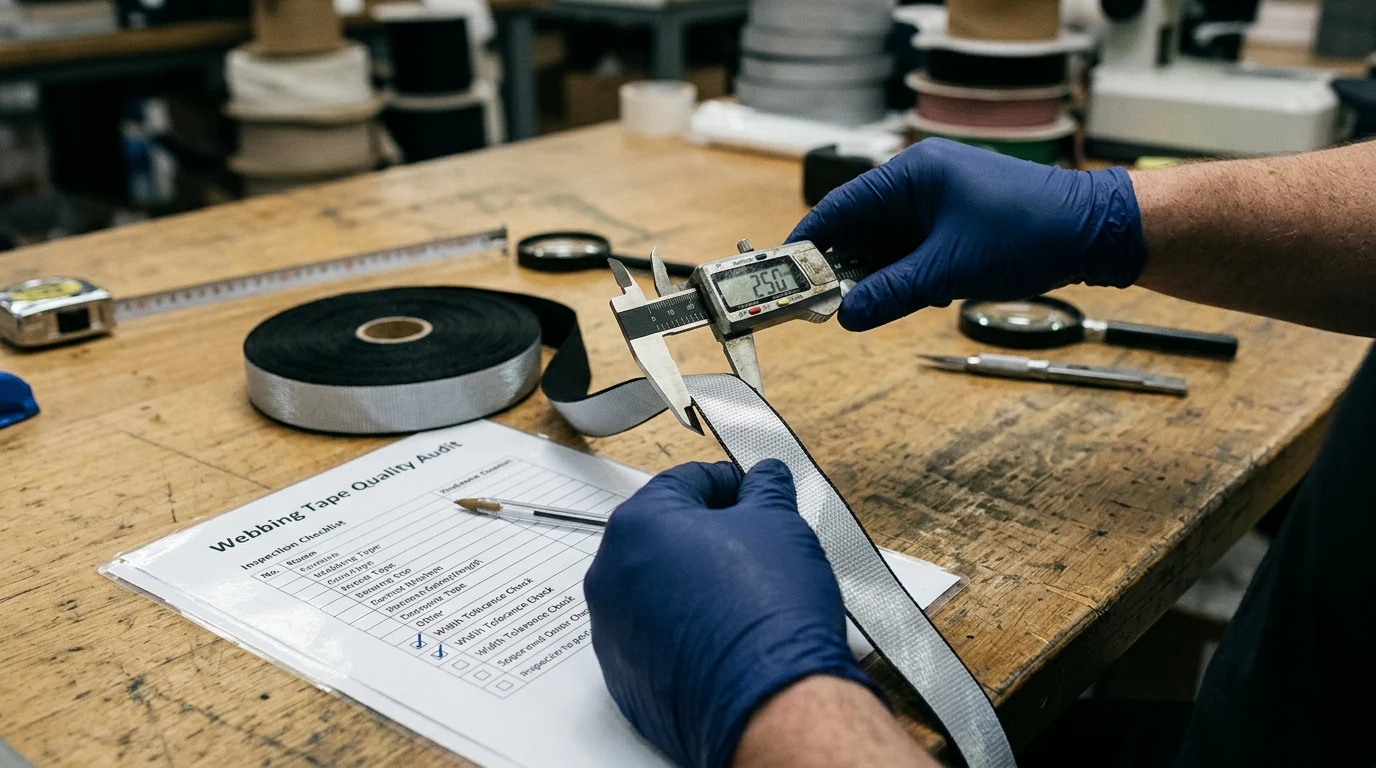
Qualifying a supplier of reflective webbing tape requires rigorous, batch-level testing. Relying solely on a supplier’s initial technical data sheet (TDS) is a frequent point of failure. Expert quality assurance teams implement incoming material inspections using handheld spectrophotometers (measuring at standard observation angles of 0.2° and entrance angles of 5°) to verify the $R_A$ values across the entire length of the webbing spool, rather than just the outer layer.
Dynamic testing must also be part of the QC protocol. This includes subjecting lot samples to accelerated UV aging (ASTM G154) and cold-flex testing at -20°C to ensure the reflective film or yarn does not embrittle and flake off in alpine conditions. A robust supplier should maintain a defect rate—defined as localized drops in reflectivity or delamination—of less than 1.5% per 1,000-meter production run.
Regional sourcing, MOQs, lead times, and cost factors
The global supply chain for reflective webbing tape is heavily concentrated in the Asia-Pacific region, with Taiwan and mainland China producing the vast majority of high-performance technical webbing. Taiwan remains a hub for highly specialized, low-tolerance woven reflective technologies, while China offers immense scale and aggressive pricing for heat-transferred variants.
| Sourcing Region | Primary Manufacturing Strength | Typical MOQ (meters) | Average Lead Time | Est. Cost/Meter (25mm width) |
|---|---|---|---|---|
| Taiwan | High-tolerance woven, R&D | 3,000 – 5,000 | 6 – 8 weeks | $0.85 – $1.50 |
| Mainland China | Scale, heat-transfer films | 5,000 – 10,000 | 4 – 6 weeks | $0.35 – $0.90 |
| Vietnam / SE Asia | Assembly integration | 10,000+ | 8 – 12 weeks | $0.40 – $0.85 |
Minimum Order Quantities (MOQs) typically range from 3,000 to 10,000 meters per colorway and width, depending on the complexity of the weave. Lead times generally span 4 to 8 weeks but can extend to 12 weeks during peak manufacturing seasons prior to the outdoor industry’s spring/summer product launches. Cost factors are highly sensitive to webbing width and reflective surface area; a standard 25mm (1-inch) polyester webbing with a 5mm reflective center stripe typically costs between $0.45 and $1.20 per meter, with premium segmented films pushing the upper boundary of that band.
How to Integrate Reflective Webbing Tape Into Product Design
Integrating reflective webbing tape into outdoor gear is not a simple plug-and-play operation. It requires a holistic design philosophy that balances the photometric requirements of the user with the mechanical realities of cut-and-sew manufacturing. Poor integration can compromise both the visibility of the garment and the structural integrity of the load-bearing seams.
Best placement for visibility and function
To achieve optimal visibility, designers must strategically place reflective webbing tape on areas of the gear that experience the highest degree of biomotion. For backpacks, this means integrating the webbing into the shoulder harness and the hip belt, ensuring visibility from multiple approach angles. For pet gear, the chest and articulating shoulder straps are paramount.
A common engineering benchmark for 360-degree visibility in non-occupational outdoor gear is achieving a minimum continuous reflective surface area of 0.015 m² visible from any given angle. Designers must calculate the width of the reflective stripe and determine the linear length required to meet this square-meter threshold without overwhelming the product’s aesthetic (e.g., a 10mm stripe on a 25mm webbing requires 1.5 linear meters to meet the 0.015 m² threshold).
Design and production trade-offs
The primary trade-off when designing with reflective webbing tape involves balancing flexibility with reflectivity. Continuous heat-transfer reflective films add measurable stiffness to the webbing substrate. If this webbing is used in a high-flex area, such as a load-lifter strap or a sternum strap adjuster, the added rigidity can impede the smooth operation of hardware (buckles and tri-glides) and lead to premature micro-cracking of the reflective surface.
Sewability is another major production hurdle. The glass beads embedded in reflective tapes are highly abrasive. When sewing through reflective webbing—particularly during heavy bartacking at stress points—the friction can rapidly dull sewing needles and cause thread breakage. Production facilities must often reduce sewing speeds by 20% to 30% (typically to under 2,000 stitches per minute) and utilize titanium-coated needles (sizes 90/14 to 110/18) to mitigate heat buildup and maintain throughput efficiency.
Specification, prototyping, and implementation process
The implementation process must follow a strict prototyping and specification loop. Industrial designers should first specify the exact webbing width, base material, and reflective technology. During the prototyping phase, the focus must shift to destructive testing. Because the reflective application can alter the friction coefficient of the webbing, pull-testing through intended hardware (targeting a minimum slip resistance of 150–200 Newtons) is mandatory to ensure the webbing does not slip under load.
Once the prototype passes dimensional and slip testing, the final specification package (tech pack) must explicitly detail the needle types, stitch density (e.g., 8-10 SPI), and maximum sewing speeds. By locking down these production variables, brands can ensure that the transition from a highly reflective prototype to full-scale manufacturing does not result in degraded seam strength or compromised reflective performance.
How to Select the Right Reflective Webbing Tape
Selecting the optimal reflective webbing tape
Key Takeaways
- The most important conclusions and rationale for Webbing Tape
- Specs, compliance, and risk checks worth validating before you commit
- Practical next steps and caveats readers can apply immediately
Frequently Asked Questions
What is reflective webbing tape used for in outdoor gear?
It adds visibility directly to load-bearing parts like straps, belts, and harnesses, improving safety in low light without extra sewn-on tape.
How does reflective webbing tape improve nighttime visibility?
It uses retroreflection to send light from headlights or flashlights back to the source, making the wearer easier to spot from far away.
Which materials are commonly used for reflective webbing tape?
Polyester, nylon, and sometimes UHMWPE are common. Polyester is popular for UV resistance, while nylon offers higher strength.
Is woven reflective webbing better than heat-transfer film?
Woven reflective webbing is usually more flexible and durable, while heat-transfer film can offer higher initial brightness but may stiffen the webbing.
How can buyers check if reflective webbing is durable enough?
Look for abrasion and wash resistance data, such as retained reflectivity after repeated washing and use, plus tensile strength specs for the base webbing.
Post time: May-07-2026