- A factory is strongest when you need repeat production of one well-defined buckle with stable specifications.
- A sourcing partner adds value when one project requires products from several manufacturing categories.
- Supplier qualification should cover tooling, material control, testing, inspection, documentation, and export execution.
- A professional sourcing process separates sample approval, production approval, inspection approval, and shipment approval.
- The right partner is selected by project complexity, not by catalog size alone.
China buckle suppliers should be evaluated by the problems they can solve, not only by their product photos or quoted unit price. The International Chamber of Commerce identifies 11 Incoterms rules in the current Incoterms framework, showing why shipment responsibility must be defined separately from manufacturing capability. This guide explains when to use a buckle factory, when to use buckle sourcing, and how to compare both models for a reliable export program.
China Buckle Suppliers: Factory or Sourcing Partner?
The central difference is operational scope. A buckle factory owns or directly controls a production process for selected components, such as die casting, injection molding, stamping, plating, riveting, or assembly. A sourcing partner coordinates a broader supplier network and manages the commercial and technical interface between the buyer and several factories.
A factory is usually the better fit when the product is standardized, the annual demand is predictable, and the buyer can manage related items independently. For example, a brand purchasing one metal tactical buckle in repeated production runs may benefit from direct communication with a manufacturer that controls the tooling and finishing process.
A sourcing partner is usually the better fit when the order combines different product families. A travel equipment project may require plastic luggage buckles, metal snap hooks, non-elastic webbing, cord, stoppers, zippers, reflective tape, and packaging. These products often come from different production processes, so one factory rarely provides the best technical and commercial solution for every item.
| Comparison factor | Buckle factory | Sourcing partner | Practical decision score |
|---|---|---|---|
| Control of one buckle process | Direct | Managed through a supplier | Factory: 5; partner: 3 |
| Multi-category purchasing | Usually limited | Strong | Factory: 2; partner: 5 |
| Single-product technical depth | Usually strong | Depends on selected factory | Factory: 5; partner: 4 |
| Cross-factory consolidation | Limited | Strong | Factory: 1; partner: 5 |
| Buyer-side coordination workload | Higher for mixed orders | Lower when services are comprehensive | Factory: 2; partner: 5 |
The scores in this table are an editorial decision framework, not market statistics. They help a buyer match the supplier model to the structure of the purchase order.
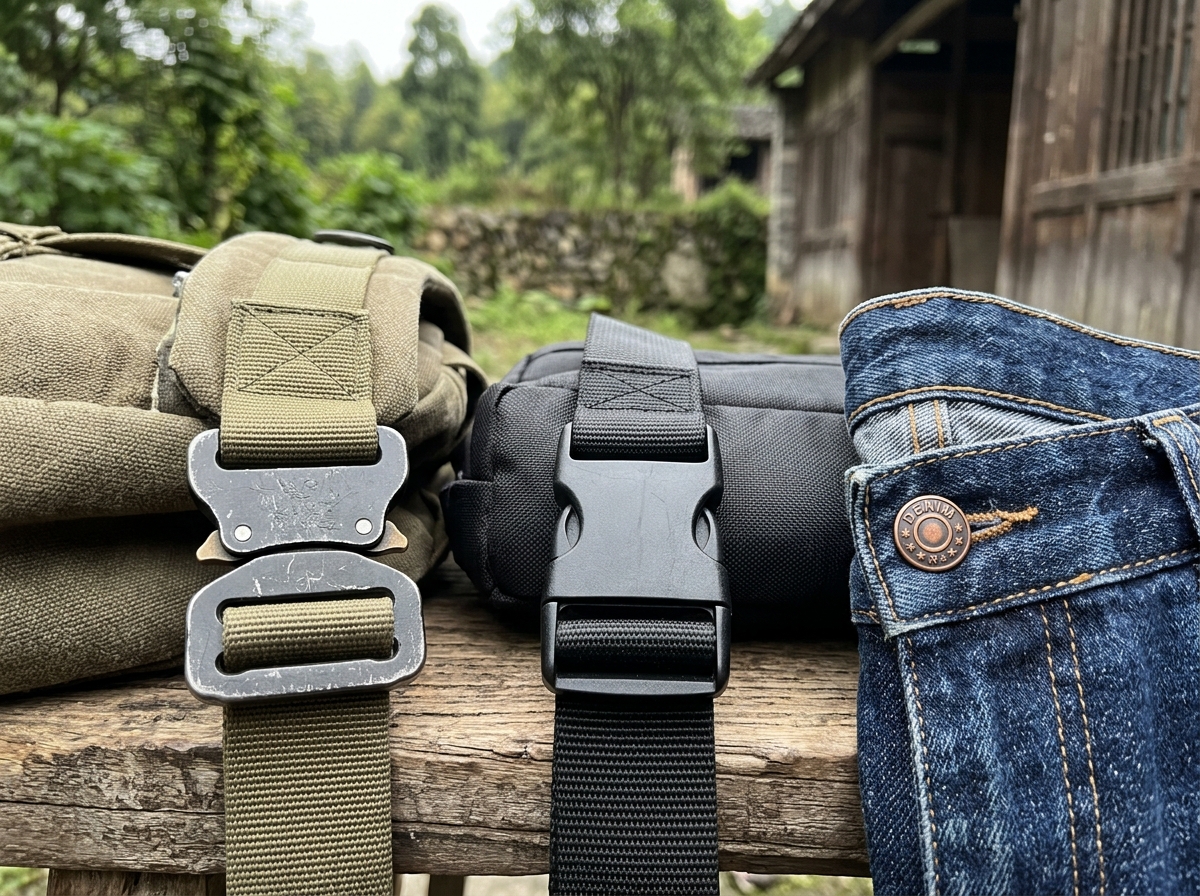 What a Buckle Factory Should Prove
A credible buckle factory should prove process ownership before discussing price. Ask which operations are performed in-house, which are subcontracted, and how the factory controls the handoff between them.
Material and process control
Material selection must match the use case rather than the appearance of a sample. Metal tactical buckles may require attention to alloy selection, wall thickness, load direction, surface treatment, and burr removal. Plastic luggage buckles require a review of resin type, molding consistency, gate position, shrinkage, and resistance to repeated opening and closing.
Finish quality is part of functional quality. Plating, powder coating, anodizing, polishing, and color matching can affect corrosion resistance, abrasion behavior, and visual consistency. A factory should explain its incoming inspection, in-process checks, and final inspection rather than simply promising “high quality.”
Tooling and change management
Tooling ownership should be documented before mass production. The buyer should know who owns the mold or die, how revisions are approved, where the tooling is stored, and what happens if the relationship ends.
Engineering changes should use controlled samples. A change to a spring, hook geometry, resin, coating, or rivet length can alter assembly performance even when the product looks almost identical. The approved sample should therefore include a drawing, material description, finish reference, packaging instruction, and revision date.
Testing matched to the application
Testing should reflect the real failure mode. A buckle used on a backpack may need pull and repeated-cycle evaluation, while a buckle used on protective equipment may also require environmental and flammability review. For clothing products entering the United States, the U.S. electronic Code of Federal Regulations, 16 CFR Part 1610 provides the flammability requirements for clothing textiles. The applicable requirement depends on the finished product, material, construction, and destination market.
| Product type | Primary risk to review | Useful evidence | Priority score |
|---|---|---|---|
| Metal tactical buckle | Deformation, sharp edges, corrosion | Material statement, dimensional check, load test, finish record | 5 |
| Plastic luggage buckle | Cracking, poor closure, molding variation | Resin declaration, sample-cycle record, dimensional report | 4 |
| Metal snap button | Weak attachment, misalignment, premature opening | Assembly trial, pull test, plating inspection | 4 |
| Metal eyelet | Fabric tearing, burrs, poor setting | Setting trial, edge inspection, finished-product test | 4 |
| Metal snap hook | Gate opening, spring failure, deformation | Functional test, dimensional report, surface inspection | 5 |
The priority scores are a practical screening tool from 1 to 5, with 5 indicating that failure could directly affect attachment security or user safety.
When Buckle Sourcing Creates More Value
Buckle sourcing becomes valuable when the buyer is managing a system rather than a single component. A sourcing partner can compare factories, align specifications, combine production schedules, arrange inspections, consolidate cartons, and coordinate export documents.
This model is especially useful for brands that need a coordinated accessory package. A bag collection may use plastic luggage buckles, metal snap hooks, quick rivets, elastic woven tape, non-elastic webbing, zippers, and cord systems. Each item has different machinery, minimum order conditions, lead-time risks, and quality checkpoints.
The best sourcing partner does not merely forward factory quotations. It converts the buyer’s product brief into comparable specifications. That may include part drawings, color references, material requirements, packaging standards, tolerance priorities, testing expectations, and delivery terms.
Supplier comparison should also include hidden coordination costs. A low unit price can become expensive if the buyer must separately chase samples, correct inconsistent colors, arrange partial shipments, translate technical messages, and resolve document errors.
How to Compare China Buckle Suppliers
A structured qualification process produces better decisions than a catalog-based search. Use the following sequence before placing a bulk order:
- Define the application, target market, material, dimensions, finish, attachment method, and expected order pattern.
- Separate standard products from custom products so that tooling and development charges are visible.
- Request samples from more than one candidate and record the revision of each sample.
- Verify factory capability through process evidence, production photographs, inspection records, or an independent audit.
- Approve a golden sample and written specification before production begins.
- Use pre-shipment inspection criteria that cover appearance, dimensions, function, packing, carton marks, and quantity.
- Confirm the trade term, export documents, consolidation plan, and responsibility for transport risk.
The World Trade Organization trade facilitation overview explains why predictable customs procedures and documentation matter to cross-border shipments. In practice, the sourcing partner or exporter should clarify who prepares commercial invoices, packing lists, certificates, shipping instructions, and any destination-specific documents.
Cost, MOQ, and Lead-Time Questions
Price comparison is meaningful only when the quotations describe the same product and service scope. Confirm whether the quoted figure includes tooling, sample charges, color matching, individual packing, inspection, export packing, domestic transportation, and consolidation.
Minimum order quantity should be viewed as a production constraint, not a universal quality indicator. A factory may set different minimums for standard stock, custom colors, new tooling, plated metal, molded plastic, or mixed sizes. A sourcing partner may be able to combine related orders, but the buyer should confirm whether this changes production timing or inspection coverage.
| Commercial item | Question to ask | Risk if unclear | Review stage |
|---|---|---|---|
| Tooling | Is the mold or die new, existing, transferable, or buyer-owned? | Unexpected charge or loss of control | Before sampling |
| MOQ | Does the minimum apply by color, size, finish, or total order? | Excess inventory or delayed production | Before quotation approval |
| Lead time | Does the estimate start after payment, sample approval, or material confirmation? | Unrealistic launch schedule | Before purchase order |
| Inspection | Who checks goods and what happens after a failure? | Late discovery of defects | Before production |
| Shipment term | Which party handles transport, insurance, customs, and risk transfer? | Unexpected logistics liability | Before contract |
Words such as “fast delivery” and “competitive price” are not measurable commitments. A dependable quotation states the product revision, quantity basis, currency, trade term, packing method, production assumptions, and validity period.
Compliance and Documentation for Export Orders
Compliance responsibility must be assigned by product and destination rather than assumed from the supplier’s location. Buckles used in apparel, children’s goods, personal protective equipment, luggage, outdoor products, or industrial applications may face different requirements.
For European Union consumer products, buyers should review the applicable obligations under the General Product Safety Regulation on EUR-Lex. The regulation does not make every buckle subject to the same test, but it reinforces the need for product safety assessment, traceability, and responsible market placement where applicable.
A sourcing partner should help collect evidence, but the importer or brand remains responsible for confirming the legal requirements for the finished product. Useful records include material declarations, test reports, inspection reports, production batch references, packing details, and approved artwork.
Factory or Sourcing Partner: A Practical Decision
Choose a factory when one product is technically central, demand is repeatable, and your team can manage other components and export coordination. Choose a sourcing partner when the order contains several categories, suppliers, processes, or delivery points.
The strongest sourcing model is not automatically the one with the largest supplier list. It is the model that provides transparent factory selection, clear specifications, controlled samples, documented inspections, realistic logistics planning, and accountable communication.
TRAMIGO describes its role as a China supply-chain integration and export procurement service covering buckles, webbing, zippers, reflective materials, hook and loop tape, and related accessories. Its stated network of more than 2,000 cooperating factories is most relevant to buyers managing multi-category or project-based orders, where comparison, consolidation, quality coordination, and shipment execution matter as much as the component itself. Explore the company sourcing service to assess whether this model fits your procurement requirements.
FAQ
What is the main difference between a buckle factory and a sourcing partner?
A buckle factory manufactures selected buckle products and controls specific production processes. A sourcing partner coordinates factories, quotations, samples, inspections, consolidation, documentation, and shipment across several product categories.
Should I buy directly from a China buckle factory?
Direct purchasing can work well when the product is standardized, the order is repeatable, and your team has the technical and logistics capacity to manage the relationship. It is less convenient for mixed accessory programs.
When is buckle sourcing better than direct factory purchasing?
Buckle sourcing is usually more practical when one order requires metal, plastic, textile, reflective, and packaging components from different factories.
How can I verify a buckle supplier?
Request process details, business documentation, samples, material information, tooling ownership terms, inspection records, and references relevant to your application. Consider an independent factory audit for higher-risk orders.
What information should be included in a buckle inquiry?
Include drawings or dimensions, material, finish, color, load or functional requirements, attachment method, packaging, estimated quantity, destination, sample expectations, and target delivery window.
Are low prices from China buckle suppliers always better?
No. Compare the full landed-cost structure, including tooling, sampling, inspection, domestic transport, export packing, freight, customs responsibilities, and the cost of managing several suppliers.
Can one sourcing partner supply buckles and webbing together?
It can, if the partner has suitable factory access and can manage different specifications, production schedules, inspection methods, and packing requirements. Confirm each category separately rather than assuming one approval covers the full order.
About the Company
TRAMIGO supports overseas buyers with China supply-chain integration rather than serving only as a single-product manufacturer. Its capabilities cover product search, quotation comparison, sampling, factory coordination, quality inspection, consolidation, documentation, and logistics for buckles, webbing, zippers, reflective materials, hook and loop tape, and functional accessories. For a multi-category project, visit the sourcing service page to review the process and submit a procurement inquiry.

Post time: Oct-08-2026